by Aaira Gupta
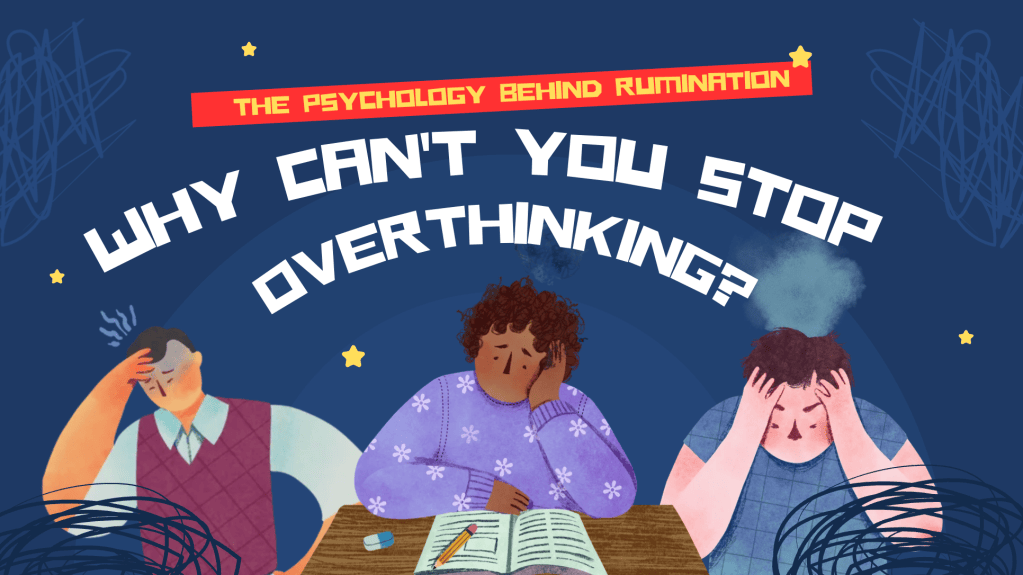
Overthinking is the process of repeatedly focusing on negative thoughts about situations in the past or worries about the future (Camacho, 2024). Essentially, it is when we can’t stop ourselves from thinking about something that is out of our control in the present.
While it may feel productive in the moment, it can be really damaging in the long run.
It is something everyone has done at least once in their life. Struggling to fall asleep because you keep thinking about an embarassing moment from earlier in the day may sound familiar.
According to one study, nearly 73% of 25 to 35 year olds have experienced overthinking at least once in their life (Camacho, 2024).
So why is it that our brains focus on situations or experiences that we can’t control? In this blog post I will explain the psychology and neuroscience behind overthinking as well as strategies on how to limit the behavior.
What is Overthinking?

Like stated previously, overthinking refers to dwelling on the past or future. Contrary to what some may believe, overthinking is actually not always a bad thing and is at times necessary for us as humans to improve and develop.
For example, after failing a test if you think about why you failed so that you can be better prepared for the next test that is a positive way to look back at old situations.
However, if you overthink about the test you failed with self-deprecating comments such as “Why am I like this” or “What if I always mess things up” it is not helping you at all and actually de-motivates you for the next test or opportunitity to improve.
Severe overthinking can actually turn into rumination. Rumination refers to the idea of compulsively focusing on negative thoughts. There are many links to rumination and depression and anxiety which is why it is essential to ensure that you are not engaging in overthinking excessively (“Overthinking: Causes, Psychology, and Attachment Styles”, 2026).
Why Does Our Brains Overthink?

Negativity Bias
This psychological phenomenon refers to the idea that as humans we tend to place more weight on our negative experiences or thoughts compared to our positive ones (Mead, 2025).
This may help explain why we dwell on one awkard moment even after it follows many perfectly normal interactions. Since negative moments capture our attention more easily, it is important to practice gratitude and recognize the positive things in our lives.
The Brain Is Trying To Protect You
Because we place such an emphasis on what goes wrong, overthinking is our brain’s way of protecting us from the disappointment, uncertainty, and vulnerablity of not being in control (Benezra, 2025).
By replaying something in your head over and over again it may create the feeling that you are preparing for every possible outcome. However, this only ultimately causes more stress and worry especially if there is nothing to be done about the situation.
Uncertainty
Our brains are designed to seek certainty but in a world where humans have more access to information than ever before, there is also more uncertainty than ever before (“The Brain’s Response to Uncertainty and Ambiguity”, 2025). Although this seems counterintuitive, having access to more information may increase uncertainty because we are unsure of who to believe with sources saying differing things.
Since we have established how the brain dislikes uncertainty, this helps explain why situations such as waiting for a text back or a college decision can be so triggering for people.
Overthinking may temporarily give a sense of control, even though it does not actually get rid of this uncertainty.
Emotions can reinforce the loop
When something negative happens, you may start having negative thoughts which thus result in more negative emotions. This becomes a destructive cycle, as negative feelings increase the likelihood of participating in overthinking which then creates even more negative feelings.
Why Teenagers May Be Especially Prone To Overthinking
Because adolescence often involves major changes in social relationships, identity, independence, and more, peer approval can feel especially important (Snelling, 2025).
As mentioned before, humans dislike having uncertainty and teenagers experience a lot of uncertain emotions.
Additionally, emotional and cognitive systems are still in the process of developing throughout adolescence. This increased self-consciousness may make social mistakes or embarrassing moments seem especially significant.
What Overthinking Can Do to You
Mood
- Greater negative mood
- Rumination is associated with depression and anxiety symptoms
Sleep
- Thoughts often become more noticeable when external distractions disappear at night
- Worry can make it harder to fall asleep
Concentration
- Mental resources are occupied by repetitive thoughts
- Can interfere with schoolwork or other tasks
Decision-making
- More thinking does not always equal better decisions
- People can become stuck trying to find a “perfect” choice
Relationships
- Reading too much into messages or interactions
- Repeatedly seeking reassurance
- Assuming what someone else is thinking without actually knowing
How Can You Actually Break the Cycle?

Before I explain what you can actually do, here is something you should not do. Don’t try to stop overthinking by simply telling yourself “don’t think about this.” This rarely ever works; For example, if I said to not think about a white bear, you would automatically think of one even though I told you not too. Trying this may increase stress and frustration as well as demotivate you in the long run.
Here are a few ways to limit overthinking instead.
The first step is simply naming what you are experiencing. By acknowledging the action out loud, distance is created between the person and the thought. This is also the easiest thing to start doing especially if you have trouble not overthinking.
The second thing you can do is challenge you existing assumptions. For instance, if you are assuming how a certain person feels or thinks it can lead to unnecessary negative feelings or emotions. Ask yourself what evidence you have for believing the things you think.
Another thing you can do is try out new activities. These can act as healthy distractions to overthinking. Examples include hobbies, talking to someone, or exercise.
Practicing mindfulness allows you to observe you thoughts instead of eliminating them. Noticing is the first step, without acknowledgement you cannot work to fix this negative behavior.
The last and biggest tip would be to take action whenever possible. What this means is that if you are worried someone is upset with you just ask them. If you are worried about a test just study. By acting instead of ruminating you have fewer regrets and less stress. It is harder to overthink if someone tells you how they are truly feeling and you believe them.
That is it for this topic. Please leave a comment on what you thought about it!! If you would like more posts like this let me know. Thank you so much for reading!!!
Sources
Benezra, Ellen. “Why Overthinking Is the Mind’s Way of Protecting the Heart.” Wellness Collective Therapy Group, 10 Apr. 2025, http://www.wellnesscollectivenw.com/blog/why-we-overthink. Accessed 4 Oct. 2026.
Camacho, Brenda. “Why Do I Overthink Everything? A Psychiatrist Explains | Talkiatry.” Www.Talkiatry.Com, 28 Feb. 2024, http://www.talkiatry.com/blog/why-do-i-overthink-everything. Accessed 4 Oct. 2026.
—. Attachment Project, 26 Mar. 2026, http://www.attachmentproject.com/psychology/overthinking/. Accessed 4 Oct. 2026.
Mead, Sarah. “Breaking the Bias: Turning Negativity Into Positivity.” Gryphon Place, 15 Apr. 2025, http://www.gryphon.org/post/breaking-the-bias-turning-negativity-into-positivity. Accessed 4 Oct. 2026.
“The Brain’s Response to Uncertainty and Ambiguity.” Default, APS, 2025, http://www.physiology.org/publications/news/the-physiologist-magazine/2025/november/the-brain-in-a-chaotic-world?SSO=Y. Accessed 4 Oct. 2026.
Snelling, Hayley. “Teen Overthinking & Negative Thought Patterns: Signs & Help.” Mission Prep Teen Treatment, 20 Oct. 2025, missionprephealthcare.com/mental-health-resources/cognitive-symptoms/rumination/. Accessed 4 Oct. 2026.


Leave a comment