by Aaira Gupta
It’s normal to act differently when around your friends compared to your teachers or parents. While we may act more laid-back and authentic around our peers, we can turn almost into a different person around people with the power to change our lives.
Not only do we change ourselves around those with higher authority, but the way we behave can change depending on the specific friend we are with. From a young age, we’re taught to always be ourselves. So why do we act differently around different people?
Does pretending to be someone we’re not mean that we are being fake or could all of these versions of ourselves be real? Psychologists have spent decades studying why humans adapt their behavior to different environments.
This blog post will explore why we may be inclined to do this using psychological research as supporting evidence.
The Psychology Behind Changing How You Act

Photo by Andrea Piacquadio on Pexels
Self-presentation is the psychological concept that suggests that we adjust the way we present ourselves depending on who is watching and how we want to be perceived (American Psychological Association, 2018).
While you might try to appear responsible and hardworking around your teachers, with your friends, you may try and seem funny and outgoing. Although you are the same person, you present different sides of yourself depending on the impression you want to make.
But why do some people change their behavior more than others?
Self-monitoring is another psychological concept that claims that some people may be particularly sensitive to social cues and adjust their behavior to match the situation (American Psychological Association, “APA Dictionary of Psychology”, 2018).
Those who are high in self-monitoring tend to adapt more to different social environments, while those who are low in self-monitoring tend to behave more consistently with their internal feelings/beliefs.
Changing you you behave does not necessarily mean you’re being fake. Rather, you’re simply adjusting to the people & environment around you.
Why Does Our Brain Want Us to Fit In?
Like basic biological needs such as drinking water and eating food, humans have a fundamental psychological motivation to belong.
This means that we like to be associated with a group of people and that we also have a drive for maintaining positive and deep relationships. Humans aren’t meant to be alone and research has shown being alone for extended periods of time can have devastating consequences.
This desire to belong can be explained through a psychological concept called the social identity theory, developed by psychologists Tajfel and Turner. According to the theory, the groups we belong to play an important role in shaping how we see ourselves (American Psychological Association, “APA Dictionary of Psychology”, 2018).
This can be seen in your different friend groups. For example, you may be loud and super talkative in one group while quieter/more reserved in a different group. Without even realizing it, we may change our behavior based on the people around us in order to feel more accepted within the group.
Avoiding talking about something you love because your friends find it embarassing or using certain slang because everyone around you does are examples of this.
It is important to note that while adapting to different environments is normal, there is a difference between fitting in and changing who you are just to gain approval.
The Neuroscience Behind The Behavior
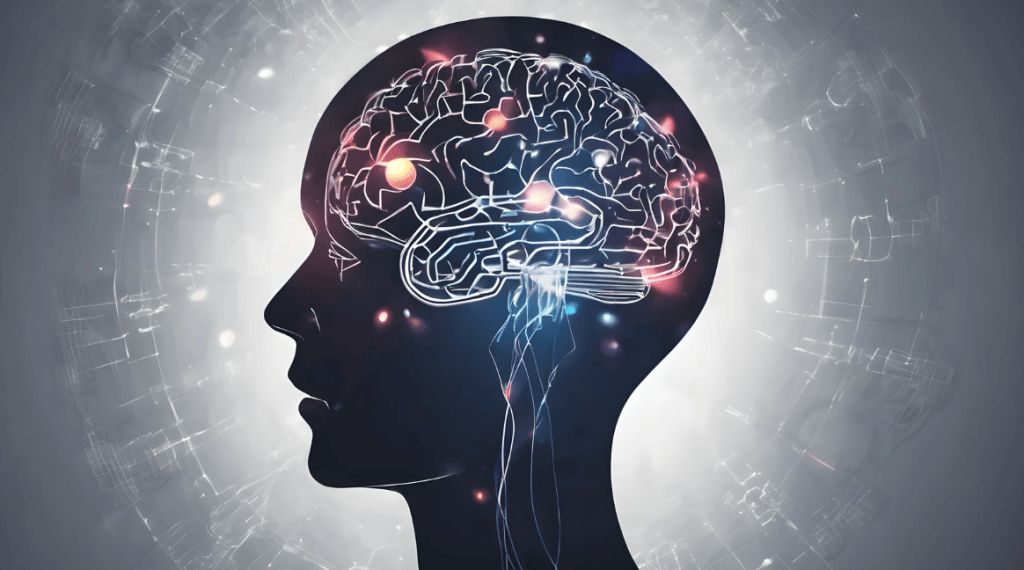
Neuroscientists use the term social brain to describe the parts of the brain that are involved with understanding others and navigating daily social interactions. Two important regions include the Medial prefrontal cortex and the Temporoparietal junction (Blakemore, 2008).
- Medial prefrontal cortex (mPFC): This brain part is involved with thinking about ourselves and other people, including their possible thoughts/intentions.
- Temporoparietal junction (TPJ): This brain part helps us to understand other people’s perspectives, beliefs, and intentions.
These brain regions is what is responsible for our behavior when navigating social situations.
When you’re about to make a joke to your friends, you might automatically first consider if they will think it’s funny. Around someone else you may evaluate the same joke differently.
Additionally, we may feel the need to act differently because being accepted by a group can feel rewarding. This may motivate us to repeat behaviors that recieve positive reactions. Even if it isn’t how we would normally act, our brain rewards positive feedback from others.
In one study, researchers recruited 19 teenagers to first rate artwork independently. Several weeks later, the teens rated the artworks again but this time after seeing a parent or another student’s rating. Findings showed that 17 of the 19 teenagers shifted their ratings toward’s their peer’s opinions on average (Welborn et al., 2015).
This demonstrates how easily teenagers in paticular can change their minds or thoughts about something. Even though they may claim to have their own opinion, this can be swayed to match whatever the group is thinking.
The study also provides an explanation as to why we may act differently around others. Since everyone has different thoughts and opinions and humans like to be rewarded with positive feedback, our own thoughts/behaviors are subject to change.
What is interesting to consider is how these brain systems continue to develop throughout adolescence. Our brains are constantly interpreting social information and helping us adapt to the people around us.
Does Acting Differently Mean You’re Fake?

Authenticity refers to the idea of being genuine and real to yourself rather than being someone you’re not.
You may ask yourself the question, If I act differently around others, am I actually being myself?
The answer to this question is yes. Even if you find yourself being more quiet/reserved with some and more loud with others, neither version of yourself is necessarily fake. You are simply expressing different sides of yourself depending on the environment.
However, there is a big difference between adapting to your environment and pretending to be someone you’re not.
While changing your sense of humor is normal, pretending to agree with opinions you don’t believe in, hinding your interests, or changing your values just to gain approval is not. The result of this is feeling disconnected from yourself.
Being authetic doesn’t mean acting the same around everyone. It means staying connected to who you are, even when the way you express yourself changes.
How To Stay True to Yourself While Adapting to Others
Here are a few things to keep in mind that can help you stay true to yourself:
- Recognize when you are adapting vs pretending
- Understand your own beliefs and values
- Surround yourself with people who make you feel comfortable being yourself
Different people can bring out different parts of your personallity and that is perfectly normal!!! The most important thing is not losing sight of who you are along the way.
That is it for this topic. Please leave a comment on what you thought about it!! If you would like more posts like this let me know. Thank you so much for reading!!!
Sources
American Psychological Association. “APA Dictionary of Psychology.” Dictionary.Apa.Org, 19 Apr. 2018, dictionary.apa.org/self-presentation. Accessed 28 Oct. 2026.
—. “APA Dictionary of Psychology.” Dictionary.Apa.Org, 19 Apr. 2018, dictionary.apa.org/self-monitoring. Accessed 28 Oct. 2026.
—. “APA Dictionary of Psychology.” Dictionary.Apa.Org, 2018, dictionary.apa.org/social-identity-theory. Accessed 28 Oct. 2026.
Blakemore, Sarah-Jayne. “The Social Brain in Adolescence.” Nature Reviews Neuroscience, vol. 9, no. 4, Apr. 2008, pp. 267–277, http://www.nature.com/articles/nrn2353, 10.1038/nrn2353. Accessed 28 Oct. 2026.
Welborn, B. Locke, et al. “Neural Mechanisms of Social Influence in Adolescence.” Social Cognitive and Affective Neuroscience, vol. 11, no. 1, 21 July 2015, pp. 100–109, 10.1093/scan/nsv095.


Leave a Reply